
The Kennelworks Standard
One standard for every dog.
Thirteen core skills, one 0 to 10 grading scale and four Core badges, from Foundations to Elite. Any dog, any breed, any trainer, measured the same way, so owners know where their dog is at and a trained dog’s training means something.
Free PDF · No sign-up
Why a standard
Ask ten trainers if a dog has a solid recall and you’ll get ten answers.
Dog training has no shared measure. “Good recall”, “fully trained” and “bombproof” mean whatever the person saying them wants. Owners can’t tell how far their dog has come, trainers can’t show what their work achieves, and buyers of trained dogs take the seller’s word for it. The Kennelworks Standard fixes that with one published scale that every trainer grades against and every owner can read.
For owners
Know where your dog is really at. A 7 for recall means the same thing whoever graded it, so you can see what’s solid, what needs work and what the next badge takes.
For trainers
Show your results in a language every client understands. Grade against a published standard, award badges that carry your name, and prove what your training does.
For buyers of trained dogs
“Fully trained” means something different to every seller. A badge says exactly what the dog did, at what grade, and who graded it, and it stays with the dog when it changes hands.
The 13 core skills
The everyday skills every dog needs.
Whether it’s a family pet, a gundog or a protection dog, these are the skills that make it safe and easy to live with. Every badge is measured on all thirteen.
- 01Name response
- 02Sit
- 03Down
- 04Stay
- 05Recall
- 06Leave it
- 07Drop
- 08Wait
- 09Loose lead walking
- 10Greeting people calmly
- 11Settle
- 12Dog neutrality
- 13Handling and grooming
The grading scale
0 to 10, and every number means something.
Each score is defined by how the dog takes the cue, how reliably it does it, and where and with how much going on. Grade what the dog does today, not its best day.
| Score | Level | Cue and help | Reliability | Where and distraction |
|---|---|---|---|---|
| 0 | Not started | Not taught yet | No response | – |
| 1 | Just started | BehaviorBehaviour captured or lured now and then | Under half the reps, even with a lure | Home, none |
| 2 | Following a lure | Lure in hand | Most reps with the lure | Home, none |
| 3 | Learning with a lure | Lure fading to an empty-hand signal; verbal cue being added | About 7 in 10 with the signal | Home, none |
| 4 | On cue, patchy | Verbal cue or signal alone, but sometimes needs a repeat or body help | About 7 in 10 on the first cue | Home, none |
| 5 | Reliable at homeFoundations | First cue, no lure (reward after) | 9 in 10 first cue | Home or training room, none; entry-level distance and duration |
| 6 | Generalising | First cue | 8 in 10 first cue | Two or more familiar places, including outdoors; low distraction |
| 7 | Reliable with distractionsIntermediate | First cue | 9 in 10 first cue | Familiar public places (class, local park); low to medium distraction |
| 8 | Reliable out and about | First cue, rewards intermittent | 9 in 10 first cue | New places; medium distraction; working distance and duration |
| 9 | ProofedAdvanced | First cue, rewards delayed or occasional | 9 in 10 first cue | Anywhere; high distraction; full distance and duration |
| 10 | Proofed anywhereElite | First cue, no reward needed in the moment | 10 in 10 first cue | High distraction in novel places, with another handler too, held on at least two different days |
Rules of thumb
- A rep counts when the dog responds to one cue within about two seconds and meets the criteria for that level. A second cue is a failed rep.
- Grade the level the dog meets today, not its best day. A dog that regresses gets a lower grade.
- If a dog meets a level’s distraction but not its distance or duration (or the reverse), grade the lower level.
- Corrections, lead pressure or physical help in the moment cap the grade at 4.
Distraction levels
- None
- Indoors, no one moving, no food or toys loose
- Low
- Garden or quiet street, a familiar person moving about, a toy on the floor out of reach
- Medium
- Group class with dogs 3 m+ away, people walking past, food on the floor at a distance, park with dogs in the distance
- High
- Dogs playing or running close by, joggers and cyclists, food dropped near the dog, wildlife or livestock in view, busy high street, the dog’s known triggers
The Core badges
Four Core badges, earned on grades alone.
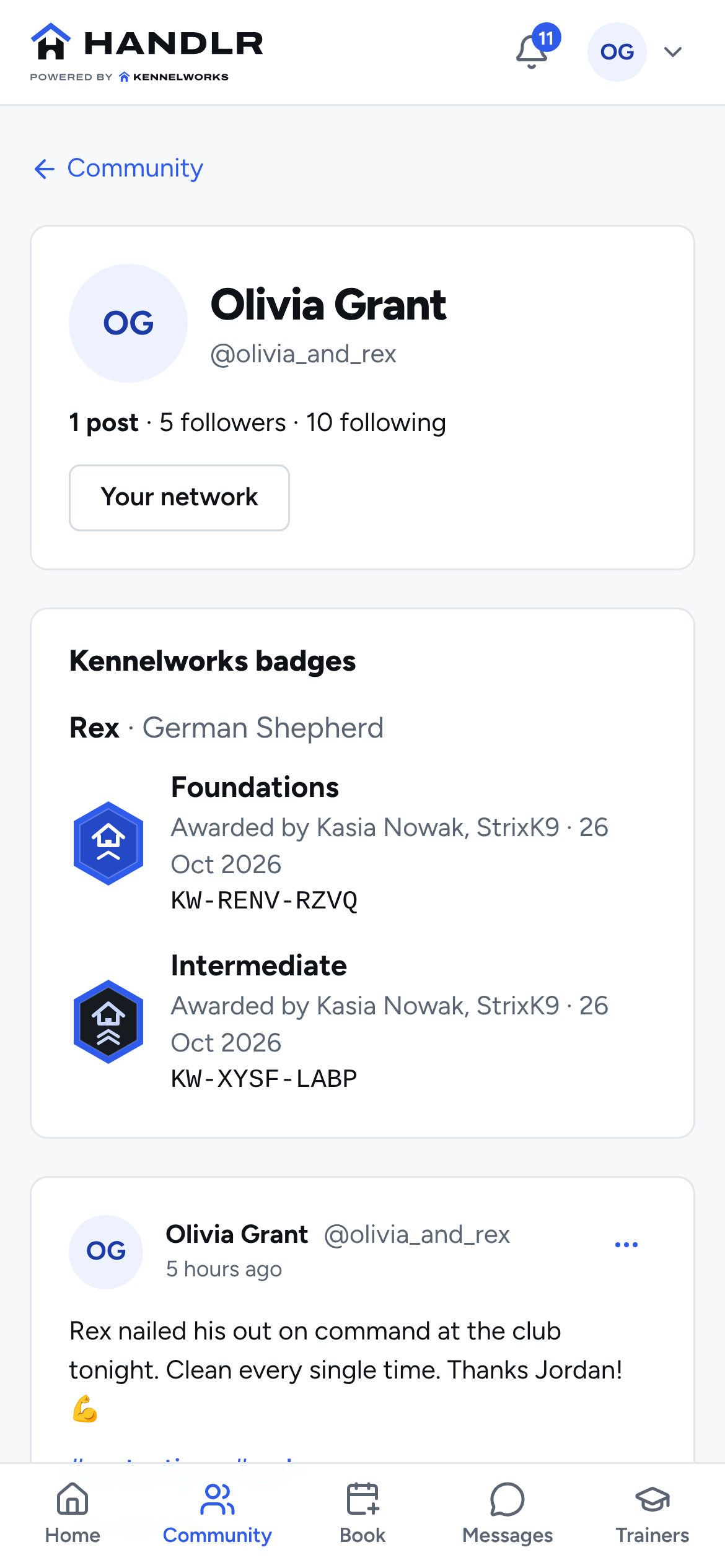
The Core series measures the 13 core skills every dog needs. Kennelworks designs the badges and sets the criteria. A trainer awards one when their grades show the dog meets it, and it goes on the owner’s Handlr profile and stays with the dog.
Foundations
Reliable at home on the first cue, with no lure.
5 or more on every core skill
Intermediate
Reliable with distractions in familiar public places, like class or the local park.
7 or more on every core skill
Advanced
Proofed under high distraction anywhere, at full distance and duration.
9 or more, on two different days
Elite
Proofed anywhere, in new places and for any handler, with no reward needed in the moment.
10 on every core skill, on two different days
- Each badge needs every one of the 13 core skills at its grade or above, and the badge before it.
- Only a trainer’s shared grades from the last 12 months count. Owners’ own grades never do.
- Advanced and Elite need their grades on two different days, so one good session isn’t enough.
- A skill that has since dropped below the bar holds the badge back until it’s back up.
- Every badge has its own code and names the trainer and business that awarded it, and Kennelworks keeps the record.
- Badges stay with the dog through a sale. The business that awarded one can revoke it, with a reason.
Skill by skill
What each badge looks like.
The grading guide spells out every score for every skill. Here is the grade each badge needs, skill by skill.
| Skill | Foundations · 5 | Intermediate · 7 | Advanced · 9 | Elite · 10 |
|---|---|---|---|---|
| Name response | Snaps round with eye contact on the first call 9/10 at home from across the room | Orients first call 9/10 in class or the park with dogs and people around | Breaks off sniffing, watching dogs play or a person with food on the first call | Same anywhere, for any handler, every time |
| Sit | Sits on the first verbal cue 9/10 at home, handler standing, holds 3 s | First cue 9/10 in class or park, handler at 2 m or not facing the dog, holds 10 s | First cue 9/10 with high distraction (dogs playing nearby, food on the floor), at distance, holds 30 s | Same anywhere, any handler, held across days |
| Down | First verbal cue 9/10 at home, from a sit or stand, holds 5 s | First cue 9/10 in class or park, handler at 2 m, holds 30 s | First cue 9/10 with high distraction, at 10 m+, drops fast | Same anywhere, any handler, held across days |
| Stay | Holds 30 s at 3 m at home 9/10, released on cue | Holds 1 min at 10 m in class or park 9/10, people and dogs passing at a distance | Holds 3 min at 20 m+ or 1 min out of sight with high distraction (dogs playing, food dropped near) | Same anywhere, any handler, held across days |
| Recall | Comes on the first cue 9/10 from 10 m at home or garden, arrives within reach for a collar touch | Comes first cue 9/10 from 20 m in a familiar park with dogs and people at a distance; turns away from mild distractions and allows a collar hold | Comes first cue 9/10 off lead from high distraction: out of play with another dog, mid-chase of a thrown toy, away from a person with food | Same anywhere, including off fresh wildlife scent, for any handler, held across days |
| Leave it | Leaves food or a toy on the floor on the first cue 9/10 at home and walks past on lead | Leaves food, rubbish or a toy on a walk or in class 9/10 on the first cue | Leaves high-value food thrown past it, a ball in flight, or wildlife in view, 9/10 | Same anywhere, off lead, any handler, held across days |
| Drop | Drops a toy on the first cue 9/10 at home, no food shown | Drops a ball mid-play or a found item on a walk 9/10 | Drops a tug mid-game, found food or a carcass, with high distraction, 9/10 | Same anywhere, any handler, held across days |
| Wait | Waits 10 s at the bowl, door and car at home 9/10 until released | Waits at kerbs and gates in public places 9/10, released on cue | Waits with high distraction on the other side (dogs, food, people), 9/10 | Same anywhere, any handler, held across days |
| Loose lead walking | Slack lead for a whole walk round the garden or a quiet stretch 9/10 of the time | Slack lead on a normal walk past people and dogs at a distance, 9/10 of the time | Slack lead past high distraction (dogs reacting, food, wildlife, joggers) 9/10 | Same anywhere, any handler, held across days |
| Greeting people calmly | Greets family and familiar visitors with four paws down 9/10 at home | Greets strangers calmly in public 9/10, handler can redirect | Calm with excited people, children and people who encourage jumping, 9/10 | Same anywhere, any handler, held across days |
| Settle | Settles for 15 min at home 9/10 while the handler gets on with things | Settles for 15 min in a café, pub or class while people pass | Settles for 30 min+ in busy places (dogs, children, food dropped), 9/10 | Same anywhere, any handler, held across days |
| Dog neutrality | Walks past calm dogs at 5 m on lead 9/10, takes food, responds to cues | Works in a group class 3 m from other dogs, ignores dogs on a normal walk 9/10 | Stays neutral when a dog barks, lunges or runs up to it, 9/10 | Same anywhere, any handler, held across days |
| Handling and grooming | Accepts brushing, nail trims, ear, teeth and paw checks at home 9/10 | Accepts a vet-style check from a familiar person in public, 9/10 | Accepts restraint, a muzzle if needed, injections and a full groom calmly | Same anywhere, any handler, held across days |

Find out where your dog is really at.
Book a grading session with a trainer who uses Kennelworks. They take your dog through the core skills, grade each one on the standard and talk you through what the scores mean. The grades land in Handlr, free, so you can see what’s solid, what to work on next and what the next badge takes.
Grade at home on the same scale
Log your practice in Handlr and score each skill 0 to 10 yourself. Your grades sit beside your trainer’s and are never mixed in.
Homework that moves the grade
Your trainer sets practice for the skills holding your dog back, and sees how it went.
A badge that stays with your dog
Once your dog meets the bar, the badge goes on your profile with its own code, and stays with your dog.
For trainers and kennels
Become a grader. Put your name on the standard.
Every trainer on Kennelworks grades on the standard and can award its badges. Offer grading sessions to owners who want to know where their dog is at, turn them into programsprogrammes that move the grades, and sell trained dogs with badges that prove what they can do.
- Step 1
Start on Kennelworks
Open an account for your business. 14 days free, and every client gets Handlr at no cost.
- Step 2
Teach to the standard
Start from the Kennelworks Foundations, Intermediate and Advanced programprogramme templates, built on the 13 core skills, or add them to your own programsprogrammes.
- Step 3
Grade on the guide
The grading guide is built in: choose a score and see what it means for that skill. Owners see every grade in Handlr.
- Step 4
Award the badge
Kennelworks shows how close each dog is. When your grades meet the bar, award it, and it goes on the owner’s profile with your name on it.
FAQ
Questions
Who sets the standard?
Kennelworks writes the grading guide and sets the badge criteria, so they’re the same for every business. Trainers do the grading and award the badges.
Can I use the grading scale without Kennelworks?
Yes. Download the standard and use it with any dog. Badges are awarded and recorded through Kennelworks, so there’s a record of who awarded each one, and it travels with the dog.
Do owners’ own grades count towards a badge?
No. Owners can grade their dog in Handlr on the same scale, which is a great way to practicepractise, but their grades sit beside the trainer’s and never count towards a badge.
What does a dog need for Foundations?
A 5 or more on all 13 core skills from its trainer: each one reliable at home on the first cue, nine times in ten, with no lure.
Can a badge be taken away?
The business that awarded a badge can revoke it, with a reason. A badge isn’t lost just because a dog has an off day.
Does it work for gundogs and protection dogs?
Yes. The Core badges cover the everyday skills every working dog needs too, and specialist skills are graded on the same 0 to 10 scale in a trainer’s own programsprogrammes. Discipline badge series, starting with protection and gundog, each from Foundations to Elite, are being written to sit alongside the Core series.